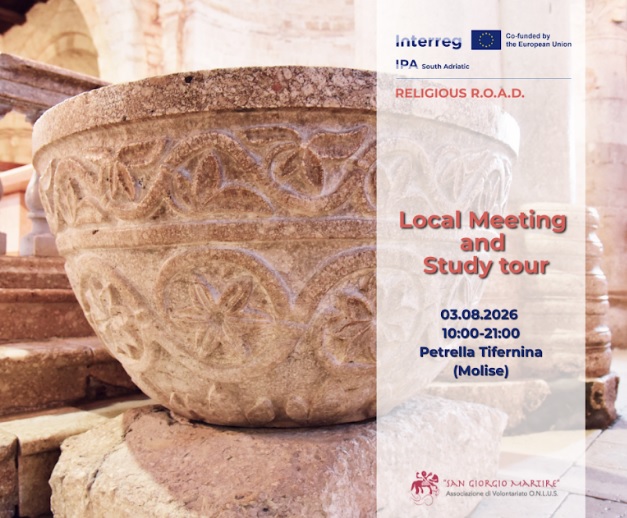
Can small villages in rural Molise transform cultural heritage into a driver of social inclusion,
intercultural dialogue and cross-border cooperation between Italy, Albania and Montenegro? The
answer is yes!
On 3 August 2026, Associazione San Giorgio Martire ETS, project partner of the RELIGIOUS
R.O.A.D. – Religious Identities inteRacting in sOuth ADriatic project, will organise a local event
offering participants a unique cultural journey through three significant religious heritage sites in
Molise.
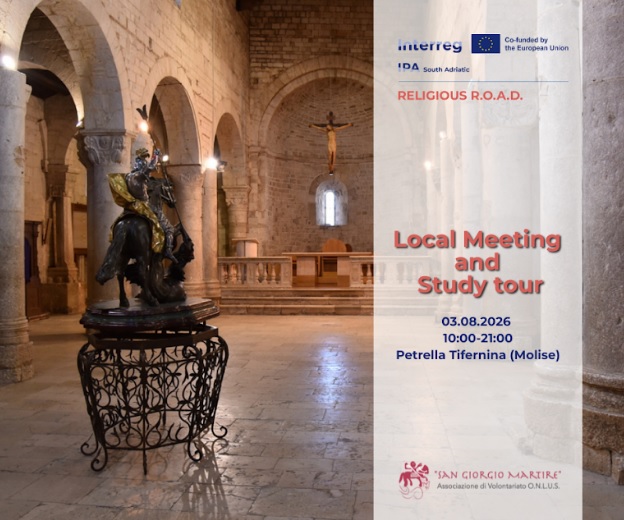
The event will explore how religious and cultural sites can become spaces for accessibility,
inclusion and intercultural exchange.
The programme will begin in Campolieto with the presentation of the project “Romanic@mente in
Cammino” and a first study tour of local places of interest. Associazione San Giorgio Martire ETS
will present this recognised religious route dedicated to the enhancement of Molisian
Romanesque heritage, launched by the Archdiocese of Campobasso-Bojano to mark the 2025
Jubilee. The route connects churches, hermitages and small abbeys in the Campobasso area
through a scenic cultural and spiritual itinerary.
A comprehensive digital heritage platform collects 3D scans, immersive virtual tours and a
dedicated app, making the area’s cultural and religious heritage more widely accessible to visitors,
researchers and local communities alike.
The journey will continue in Matrice, where participants will visit the remarkable Church of Santa
Maria della Strada, one of the most important examples of medieval religious architecture in the
region. After a light lunch, the event will move to Petrella Tifernina for a study tour of the
monumental Church of San Giorgio Martire, a landmark of Molisian Romanesque architecture and
a symbol of the region’s layered cultural history.
The day will conclude with a roundtable discussion on interreligious dialogue, intercultural
exchange and inclusion, followed by moments of conviviality and networking among participants.
Despite their small size, these villages in rural Molise have preserved their heritage and
transformed it into a catalyst for social inclusion, social innovation and sustainable development.
Through these initiatives, local cultural assets create connections that extend well beyond the
boundaries of rural communities and strengthen cooperation across the South Adriatic area.
COPY FOR SOCIAL MEDIA
��️ Can small villages transform cultural heritage into a driver of inclusion, intercultural dialogue an
cooperation across the South Adriatic?
The answer is yes.